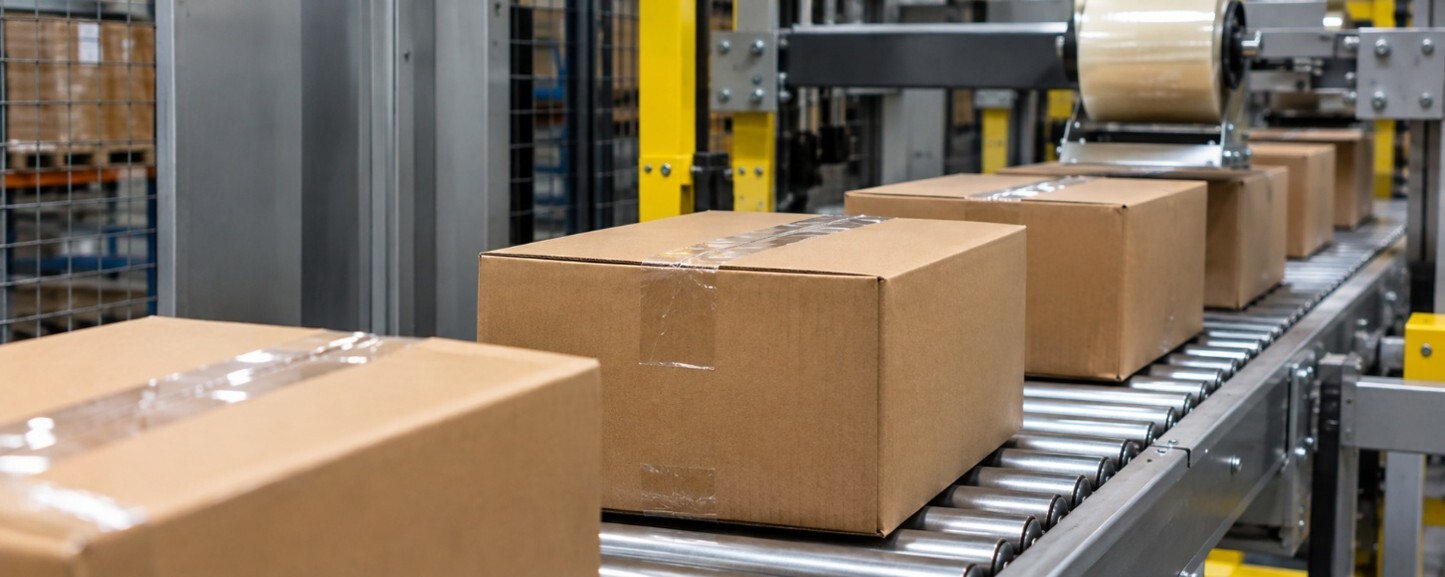
1. Automate Case Erecting and Sealing
Manually assembling and sealing cartons requires repetitive labor and can slow production, especially in facilities handling large order volumes.
Automatic case erectors and case sealers help streamline these processes by forming corrugated boxes and applying consistent tape closures. This reduces manual handling while helping maintain consistent packaging quality.
When evaluating equipment, consider production speed, carton dimensions, and whether the machine can accommodate different box sizes.
Rapid Packaging offers case erecting and sealing equipment to help manufacturers reduce manual work and improve packaging consistency.
2. Improve Product Flow with Conveyor Systems
Moving products manually between packaging stations can create bottlenecks and unnecessary handling. Even when individual machines operate efficiently, poor coordination between processes can slow down the entire line.
Conveyor systems connect equipment and help maintain a consistent flow of products between operations such as case erecting, filling, sealing, and labeling.
When planning conveyor integration, consider available floor space, product dimensions, conveyor speed, and compatibility with existing equipment.
The goal is to create a more coordinated packaging process that minimizes handling and keeps production moving.
3. Upgrade Palletizing and Stretch Wrapping
Manual palletizing can become a significant labor challenge as production volumes increase. Repetitive lifting and stacking take time and can limit how quickly finished products move through the facility.
Automatic and semi-automatic palletizers help organize finished cases, while stretch wrappers secure pallet loads for storage and transportation.
Upgrading these processes can reduce manual handling, improve load consistency, and increase end-of-line productivity. Manufacturers should also evaluate stretch film consumption and wrapping requirements to avoid unnecessary material usage.
Rapid Packaging offers palletizing, stretch wrapping, and strapping equipment for different production needs.
4. Select Packaging Materials That Work with Your Equipment
Packaging materials directly affect equipment performance. Inconsistent carton dimensions, unsuitable tape, or incompatible stretch film can contribute to jams, sealing problems, and unnecessary downtime.
Manufacturers should evaluate materials alongside their packaging equipment to ensure everything works together.
For example, selecting the appropriate tape for a case sealer can help maintain reliable carton closures, while choosing the right stretch film can improve pallet containment and control material consumption.
Standardizing materials where possible can also simplify purchasing, inventory management, and equipment setup.
Rapid Packaging supplies corrugated packaging, industrial tape, stretch film, and protective packaging materials to support manufacturing and distribution operations.
5. Reduce Downtime with Preventative Maintenance
Unexpected equipment failures can interrupt production and affect multiple packaging stations. A malfunctioning case sealer or stretch wrapper can create delays throughout the end-of-line process.
Preventative maintenance helps identify potential problems before they become costly interruptions.
Manufacturers should establish routine inspections, cleaning, lubrication, and timely replacement of worn components. Keeping maintenance records and monitoring recurring equipment issues can also help identify opportunities for improvement.
Access to replacement parts and qualified technical support is equally important when equipment requires repairs or adjustments.
Rapid Packaging provides equipment parts, maintenance, repairs, and technical support to help keep packaging operations running reliably.
Evaluate Your Packaging Setup